| Home |

| NOTE: |
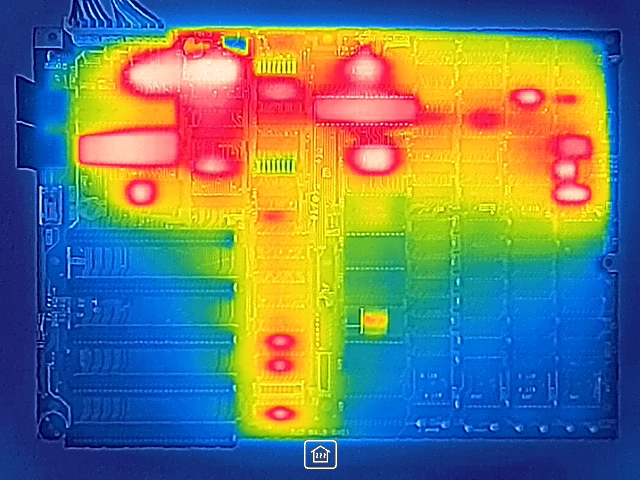
Temperatures shown below are crudely indicative only. See note 1. |
| NOTE: |
Only sometimes (repeat: sometimes), are faulty chips very signifcantly hotter than normal. It depends on the nature of the fault (the failure mode). |
![]() |
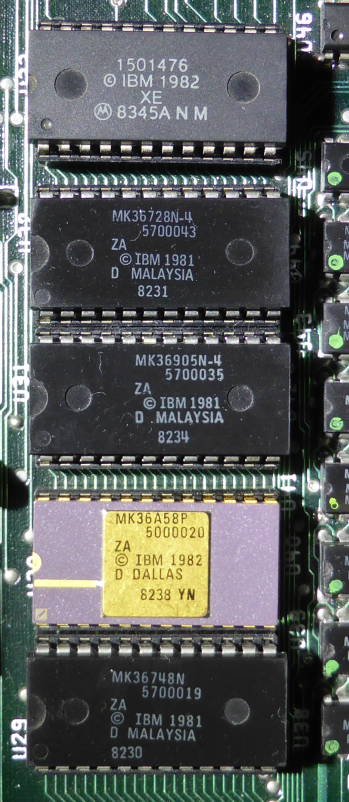
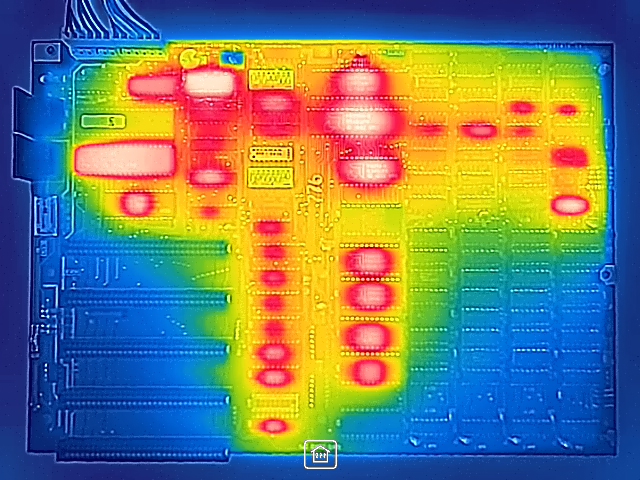
In decending temperature Intel D8284A: About 59° Celcius Intel P8253-5: About 47° Celcius U94 (SN74S280N): About 47° Celcius Intel P8255A-5: About 45° Celcius U95 (SN75477P): About 45° Celcius (See note 2 below) U8 (F74LS245PC): About 44° Celcius Intel P8259A: About 43° Celcius Intel D8088: About 43° Celcius Intel D8237A-5: About 41° Celcius Cassette BASIC ROM's: Per the photo at here, U30 on this particular motherboard has a different package type than the other ROM's |
![]() |
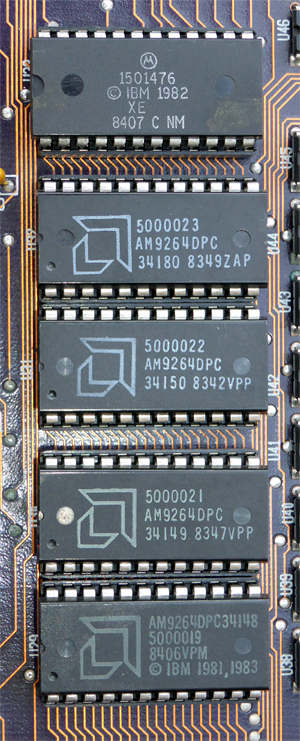
In decending temperature AMD P8237A-5: About 60° Celcius <------ !!!! About 20 degrees higher than on the 16KB-64KB motherboard above Intel D8284A: About 54° Celcius AMD P8253-5: About 54° Celcius AMD P8255A-5: About 50° Celcius U94 (SN74S280N): About 50° Celcius AMD P8259A: About 46° Celcius AMD D8088: About 46° Celcius U8 (SN74LS245N): About 43° Celcius Cassette BASIC ROM's: Per the photo at here, the four Cassette BASIC ROM's are AMD made. Is AMD's design the reason for the heat? |
| Note 1 | • Do an Internet search for factors that affect temperature readings on a thermal camera. • The surrounding air temperature is expected to affect chip surface temperature. • Different makes of a chip could emit different levels of heat (because the circuitry inside the chip might be different). • Due to the motherboard design, the same make-model of a chip in socket {XXX} could emit a different level of heat to that in socket {YYY}. |
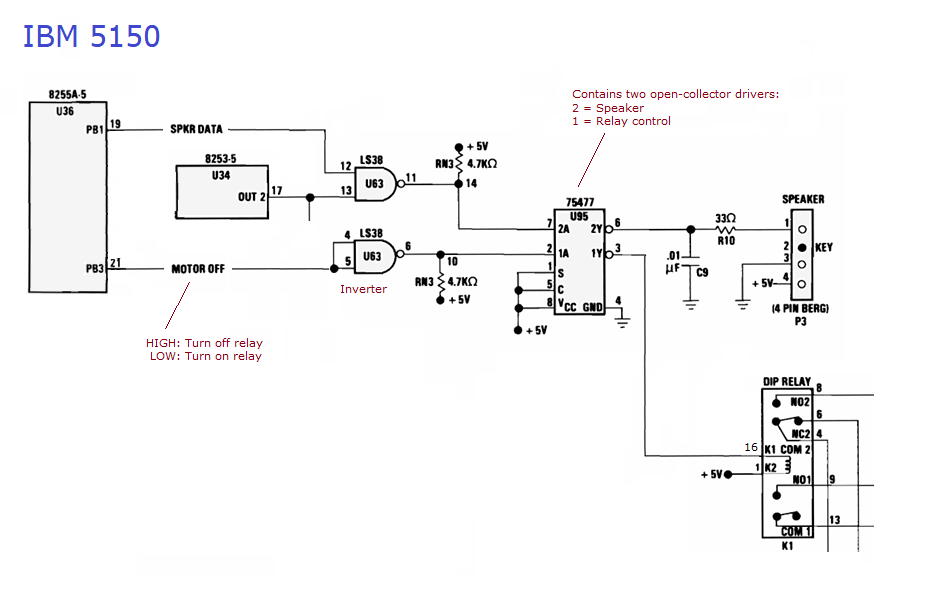
| Note 2 | A very different result to my 64KB-256KB motherboard. The cause may be related to input pin 7. My particular 16KB-64KB motherboard : pin 2 = LOW, pin 7 = HIGH My particular 64KB-256KB motherboard: pin 2 = LOW, pin 7 = LOW The 75477 is an open-collector driver. Pin 7 controls the open-collector transistor associated with the speaker, but there is no speaker connected to the motherboard. Hypothesis: Pin 7 being HIGH is turning on something in the chip, drawing significant power. |